
 |
 |
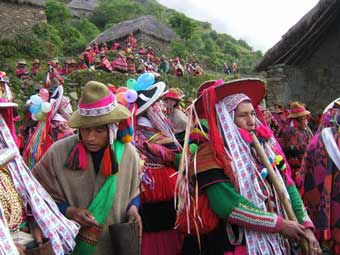
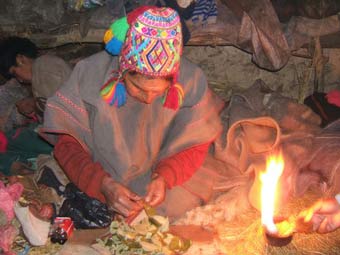
The Quechua community of Q’eros in the Andes of southeast Peru is renowned for traditional music, weaving, and spiritual rituals that many other Andean communities no longer practice. Through personal accounts, this documentary shows the annual cycle of Q’eros musical rituals, how Q’eros people use music to express grief and joy, and how an indigenous people adapt to urban society.
VIEW SHORT VIDEO CLIP:

Play with Windows Media Player: 300k or 700k
Length: 53 min.
Country: USA
Language: Quechua, Spanish, English
Producer: Holly Wissler
Producer website: N/A
Distributor: The Mountain Fund
Distributor Web site: http://qerosmusic.com
Festival Screenings and Awards:
National Society for the Society of Musicology, Columbus, Ohio, 2007
Florida State University at Tallahassee Film Center, 2007
Iowa State University 2008
Florida State University: Southeast/Caribbean Chapter of the Society for Ethnomusicology, 2008
The Hampton School of Music, University of Idaho, 2008
Boise State University, 2008
Tinkuy: Annual Anthropology Conference, Cusco, Peru, 2008
First Biannual Symposium on Teaching Indigenous Languages of Latin America, (STILLA), University of Indiana, 2008
Peruvian-North American Cultural Institute, Cusco, Peru, 2008
Southeast Conference on Amazonian and Andean Studies, Florida Atlantic University, 2008
Symposium “Archeology and Linguistics in the Andes,” London, England, 2008
The British Museum, London, England, 2008
Center for Contemporary Arts, Santa Fe, New Mexico, 2008
International Center for Integrated Mountain Development, Department of Ethnomusicology, Kathmandu University, and Indigo Gallery, Kathmandu, Nepal, 2008
| |
 |
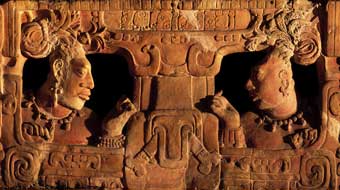

The complex and beautiful Maya hieroglyphic script was, until recently, the world’s last major un-deciphered writing system. Breaking the Maya Code is the story of the 200 year struggle, often hampered by misconceptions and rivalries, that has ultimately unlocked the secrets of one of mankind’s great civilizations and re-connected modern Maya with their extraordinary past. It’s an epic tale that leads from the jungles of Guatemala to the snows of Russia, from ancient Maya temples to the dusty libraries of Dresden and Madrid. The film is based on the book of the same title by Michael Coe, called by the NY Times “one of the great stories of twentieth century scientific discovery.”
VIEW SHORT VIDEO CLIP:
Play with Windows Media Player: 300k or 700k
Length: 116 min.
Country: USA
Language: English
Producer: David Lebrun, Night Fire Films
Producer website: www.nightfirefilms.org
Distributor: Night Fire Films
Distributor Web site: www.nightfirefilms.org
Festival Screenings and Awards:
The Maya Meetings, University of Texas, Austin, 2008
International Festival of Films on Art, Montreal, Canada, 2008
Cinarchaea International Archaeology Film Festival, Kiel, Germany, 2008
Maui Film Festival, Hawaii, 2008
De Young Museum, San Francisco, 2008
ARTE France TV, 2008
Audience Award for Best Documentary, Red Rock Film Festival, St. George, Utah
Festival Grand Prize, Arkeolan: International Archaeological Film Festival of the Bidasoa, Irun, Spain, 2008
Santa Fe Film Festival, New Mexico, 2008
| |
 |
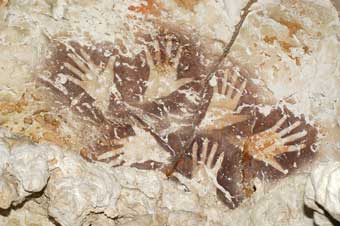
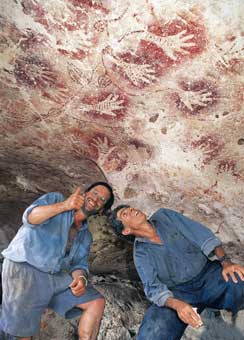
In this exceptional scientific adventure up rivers in the heart of the wild tropical rainforest of Borneo, the authors discover an unexpected rock art site more than 10,000 years old during some twelve expeditions to remote caves. Conducted by Luc-Henri Fage, speleologist and photographer; Jean-Michel Chazine, archaeologist; and Pindi Setiawan, their Indonesian partner from the Bandung Institute of Technology, this research unveils a forgotten culture, lost within remote labyrinthine limestone peaks, which sheds new light on Southeast Asian prehistory.
VIEW SHORT VIDEO CLIP:
Play with Windows Media Player: 300k or 700k
Length: 52 min.
Country: France
Language: French, English subtitles
Producer: Luc-Henri Fage, MC4, ARTE France
Producer website: N/A
Distributor: Luc-Henri Fage
Distributor Web site: http://www.kalimanthrope.com; http://www.speleo.fr
Festival Screenings and Awards:
French TV, Oct. 2004 - Dec. 2007
Awarded at archaeological festivals: Brussels, Kiel, Nyon, and Bordeaux between 2005 and 2007
| |
 |
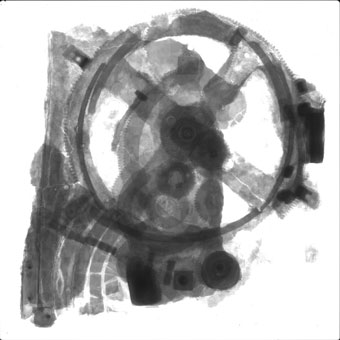
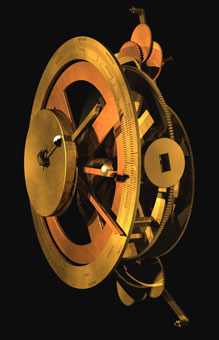
More than a hundred years ago, sponge divers discovered the remains of an extraordinarily sophisticated astronomical device off the small Greek island of Antikythera. Previously identified as an astronomical calculating machine used to predict eclipses and to set the timing of the Olympic Games, it shows the ancient Greeks had a higher level of technology hundreds of years earlier than was previously accepted. In 2006 a research team from the Antikythera Mechanism Research Project published a paper proposing a radical new model of how the Mechanism worked. Using the latest X-ray and imaging technologies and 3D animations developed from the data, revealing its remarkable complexity, Don Unwin, master instrument maker, sets out to build a working model in bronze.
VIEW SHORT VIDEO CLIP:
Play with Windows Media Player: 300k or 700k
Length: 14 min.
Country: UK
Language: English
Producer: Martin Freeth, Mfreeth.Com Ltd
Producer website: www.mfreeth.com
Distributor: Publishers/Nature Video
Distributor Web site: www.macmillan.com
Festival Screenings and Awards:
Nature's Web site, July 2008 to present